Showing posts with label kalamitsi. Show all posts

Monday, 1 May 2017

May Day, Xirosterni, Kalamitsi, Vrysses, Georgioupolis

May Day in Crete means wreaths of flowers on your door ( The crosses are the smoke from the holy candle brought home the last two years after the midnight service at Easter)


Or on the gate


..and on the car


Going down to Kalamitsi

Kalamitsi Alexandrou


A lovely lunch


In peaceful surroundings


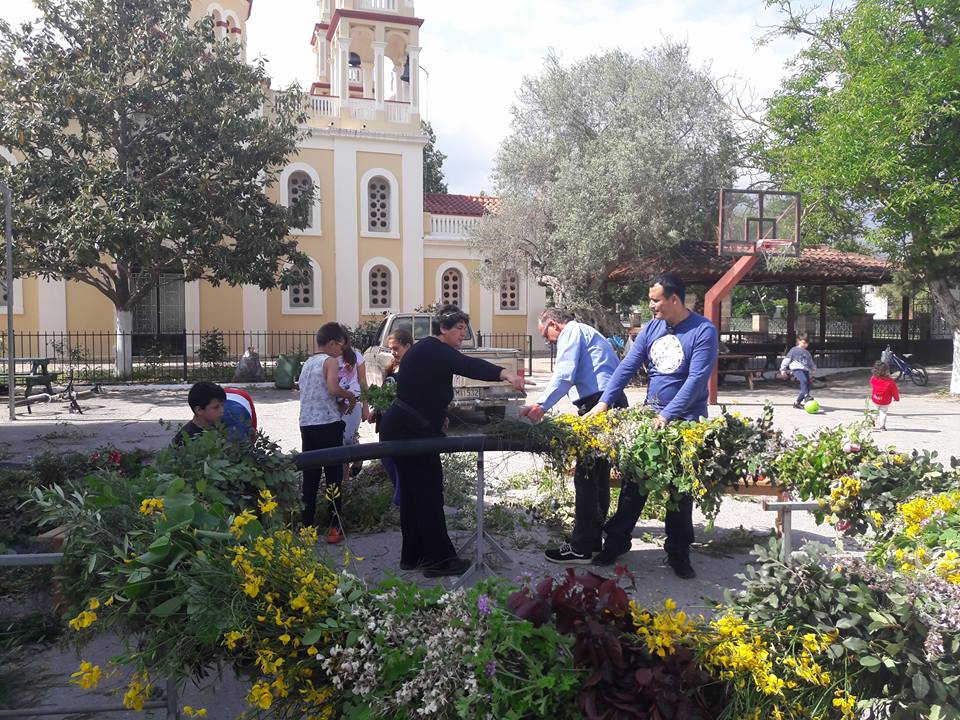
Meanwhile... down in Vrysses they were determined to have the biggest and best wreath!


Everyone helping


Well done everyone! (Photos from the syllogos)

Then down to Georgioupolis for coffee


Lots of people walking out to St Nicholas' church on the causeway


"Come on.. I am waiting to play!"


Tuesday, 25 April 2017

Miltiadis Papadogiannakis. A Pioneer of Georgioupolis

Where has the statue gone from the village square? people have been asking. Well, after a sojourn in the council chamber it has a new home in a garden at the church of the Ascension in Georgioupolis village. "Who was he?" is the next question. "What did he do?"

Miltiadis Papadogiannakis moved to Georgioupolis (Then known as Paleocastella in the province of Almyros) in 1884. His home village was Kalamitsi. At this time the village of Paliocastella was renamed Almyroupolis.


He was first president of the new "Village Association" and helped to set up an agricultural union.
They wanted Georgioupolis to become a commercial centre and set about planting hundreds of  trees, draining the swamps, fertilising them and providing free quinine to the residents - as there was a lot of malaria in the area at the time.


Around 1912 the first bridge was built over the Almyros river - then called Gargadoros


Here you can see the remains of the old bridge alongside the modern one


He died in 1934. In his will he left an area of 3000m2 for the building of the Saviour's Ascension  church ( the large church where his statue now stands) Also in his will his last wish was to be buried at St Nicholas Church - the one on the causeway - though it was just an island then. I do not know if this was carried out.


There is a lot more, and also many other people from the area instrumental in the work he spent his life carrying out - but too much for this blog!

Sunday, 22 May 2016

Finding Kalamitsi - my diary continued. ( Part 6)


….We wound back down the road, continuing on till we came to  the small village of Kalamitsi, dark and silent, the only sound of life coming from the village kafenion.
Kostas parked the car next to several others on the road.
“The cafenion is run by my cousin Petros.” Kostas told me as we went inside.
It had rough whitewashed walls with a grapevine growing around the door and suspended over the courtyard. Several old men were sitting outside playing backgammon and cards. They were rather shabbily dressed on the whole and I could see a twisted old walking stick propped up by the side of one of the tables. Some of them were twirling worry beads ‘Komboloi’ in their gnarled fingers. On the table in front of them I could see small white coffee cups and small glasses of the ubiquitous Raki.
Entering the kafenion I could see the walls were white and bare, the space was mostly empty with only a few wobbly tables and chairs for customers, the floor was concrete and a large old fashioned refrigerator buzzed away at one end of the room. At the other was, rather incongruously, a Pac-man machine where several young boys were taking turns to play, large patches of peeling plaster looming over their heads.
Kostas gestured to a rickety table; I lowered myself carefully onto the creaking chair and relaxed. Petros, the ‘Kafedzis’ quickly arrived with glasses of raki which came complete with a plate of sunflower seeds, still in their shells.
Kostas demonstrated how to nibble these, turning them onto their sides and cracking them with his front teeth, then, and leaving the kernel whole in his mouth he removed the shell. I was not so adept.
‘Obviously an acquired talent’ I thought as I tried to discreetly spit out a mouthful of mangled shells.
“Stin uyia sas” Kostas lifted his glass to mine. “Cheers” We drank.
I was beginning to realize that raki was as varied as wine in its taste. It could be pure firewater or it could be smooth and mellow.
“Never call it ‘raki’” He leaned over close to me speaking quietly. “That’s a Turkish word. Only the tourists use it. Here in Crete we call it ‘tsigouthia.”
There were a few other people in the room and he introduced me to them including his cousin Christos who was planning to open a new kafenion in the village. Christos was a cheerful man, quite short and going thin on top.
Petros brought an apple and a knife and placed it on the table in front of me.
“Peel it!” ordered Kostas. “I hesitated, Should I cut it into portions? Should I cut out the core? And besides I never peeled apples but ate them whole. I saw that Christos had noticed my hesitation from the table where he sat but I took little notice of it then. I peeled and cored the apple and cut it into eight pieces, much to my surprise Petros came over and sprinkled it with powdered cinnamon. Every one took a piece. To my relief I had guessed right.
After a while we moved to sit outside. Several tables were pushed unceremoniously together and everyone gathered round. Village wine was brought out. Salad, fish, and bread soon followed.
“We have no lemons’ announced Soula, Petros wife, appearing from the kitchen of the building next door with a steaming plate in her hand, there being no cooking facilities in the cafenion itself.
“I’ll get some” yelled back Vassilis, yet another cousin of Kostas, aged about 30 he was bespectacled and balding, who had a little white dog with him and turned out to live opposite. I soon discovered that wherever he went ‘Lisa’ was sure to follow.


“These aren’t lemons they’re limes” complained Soula when he returned with his hands full of fruit and handed them to her.
“Sorry. Wrong tree, it’s too dark to see properly.” answered Vassili with a laugh and with a leap he jumped once again over the wall into his garden and began to pick what we all hoped were lemons fresh off the tree.
“I’m pretty sure I got the right tree this time” he chuckled when he returned with his bounty his little dog following closely at his heels wagging her stumpy tail happily.
After a while and more than a little wine the singing began, one man, Manolis, tall, dark and with the traditional moustache, leading the chorus with his very powerful voice. These were songs I had never heard before, strange eastern tones and cadences, telling of revolution, love and loss. They were not like the songs of the other Greek islands; they evoked another era and another life. Apart from Soula I was the only woman there, Kafenia being the male stronghold of the villages, the women rarely venturing in. I seemed to be accepted because I was a foreigner and as is well known foreigners have strange ways!

   I certainly had a lot to tell Chris on the beach the next morning.
The following day at about one o’clock Kostas turned up once again at the beach bar and,told us some news.
“There is a fiesta, this evening near Vrysses” he informed us. “ I'll be going
will you join me?”
When we arrived I could see a dais set up for the band which consisted of rough planks of wood precariously balanced on empty beer crates. Around the courtyard were trestle tables already set with wine and raki. I was pleased to see several familiar faces, some of Kostas family was there already and they called us over to join them. The band clambered up onto their rickety stage and the music began. It was the strange Cretan music that I was becoming familiar with. As the people joined in the dancing Kostas explained to me the meaning of some of the dance steps. All the dances told a story. Kostas rose and began to dance himself, arms held high, swooping to brush his shoe and rising again to spin in time to the music the other men squatting in a circle around him clapping rhythmically in time to the music. I didn’t want the evening to end, sitting there accepted by the villagers I felt warm and welcomed as they encouraged me to join in the dancing and showed me the steps, but I knew that my time was running out.

The day of my return home came all too soon.
At the airport, as I was waiting for my flight to be announced, I heard amongst the throng the now familiar welsh lilt of Roy and Margaret they were seeing some guests off.
“You’ll be back soon.” Margaret stated the obvious kissing me on both cheeks.
“Of course” I replied.


Thursday, 19 May 2016

Trouble with the boys in blue - 1 ( some names and dates have been change to protect the………)


(Although some names and dates have been changed, there are enough clues for those of you who have know the area and the people to make guesses! this took place in about 1990)

    I was walking down the road from Kalamitsi. I had been to the village for the evening but it was very quiet and the kafenion had closed early due to illness in the family.  I decided to make my way home to the little room I was renting.
It was about nine in the evening and dark when I set out and I had no torch. As I picked my way along the side of the road trying to see the way, a police car pulled up beside me. The window wound down and the head of a young policeman poked out.
“Where are you heading?” he asked me.
Down to Georgioupolis,” I replied. The head vanished back inside the car as he consulted with his colleague .
We’re going that way. Hop in; you can have a lift with us.”
I was somewhat taken aback, but decided that I should be safe enough with two local policemen.
Thank you,” I said as I got in. There followed a muttered discussion between the two policemen, then the younger of the two turned around,
We just have to call in to Exopoli on the way down. We have a bit of business to attend to.”
When we arrived at Exopoli it became clear they did not know where they were heading. They stopped the car in the middle of the village and, turning on the siren and flashing lights, waited until someone came out to investigate. Having got directions we turned up a steep driveway and pulled up by some other cars.
  “It’s our friend's name day,” The older police officer told me. “We have a cake in the back of the car.” Looking behind me I could see a box with the name of a cake shop emblazoned on it. “We have a bit of a problem,” he continued, “That car parked in front of us belongs to our boss. If we go in he will know that we are socializing when we are on duty.” At that moment the door opened and a figure approached the car. I recognized a young man, the brother of the friend celebrating his name day, whom I had met several times in the village kafenion. They explained their predicament.
Never mind,” he told them, “I know Helen. She can come in if she wants to even though you can't.”
After a moment’s hesitation I got out of the car. I had nothing to rush back for. I checked my bearings. Where was I? Which direction was home? Having satisfied myself I knew where I was, I went into the house.
    The small room was crowded with people squashed around a large table, which was groaning under the weight of large platters containing the traditional celebratory fare of Crete; pilaffi, boiled chicken, roast lamb, pork, salad and potatoes.
Much to my relief I knew several people at the party, including the policemen’s ‘boss’. The only spare seat was next to him. I sat down accordingly. I was somewhat relieved to see that there were plenty of women and girls in the company.
The policeman leaned over and filled up my glass with wine. It was paler than the usual local wine, a golden colour, rather than the red more common to the region.
Cheers.” He said raising his glass and tapping mine. Drink up, don’t worry, I will drive you back down the road later,” he announced. The only thing I was worrying about was being in the car with him after the copious amounts of wine he was imbibing…
    The evening progressed in the usual manner, food, drink, music, dancing, singing and gunfire. The main culprit was the policeman who delighted in startling the women by firing off rounds from his gun out of the open window.
The policeman I noticed was fully armed andI discovered that the old chestnut, “Is that a gun in your pocket or are you just pleased to see me?” translated into Greek, went down very well and caused much merriment amongst the company.
I was to regret this later when later, in his car as he drove me back down to the village, he offered to show me exactly what it was that he had in his pocket!

This photo, by Nikos Kokolakis, shows pretty much where my room was - can you recognize where you are looking and what is there now?


That night, after I had successfully extricated myself from ‘police custody’, and escaped to my room I chuckled over my evening. It can’t be many people who get picked up by the boys in blue and taken to a party. It could only happen here.

Sunday, 17 April 2016

My first morning - prologue


An excerpt from my diary. The day I arrived in Crete to stay. I had visited as tourist many times before. I arrived with a suitcase and a carry on bag and 200 pounds - and that was it! Some while ago I began to put it into story form and so this is what I will post rather than the dairy itself.

March 1989

I sat for a little while outside the still closed cafeteria, enjoying the quiet, trying to read the posters pasted to its windows. My gaze wandered up and down the road. The countryside was fresh and green after the early morning rain, the village street gleaming, freshly washed by the night’s rain. Now, with the gentle heat of the morning sun the dampness in the air was evaporating, and the scent of the flowers and herbs infused the air, almost overpowering me with its heady fragrance.
“Well, can’t sit here all day!” I told myself sternly, as I stood up and glanced across the quiet street. The first thing on the agenda was to find somewhere to stay for a couple of nights while I looked for something more permanent.
I dragged my cases up the road to where I could hear voices coming from a small restaurant at the crossroads by the river. Although it was so early in the day they were already busily preparing for the day ahead. Being a Sunday it was likely to be hectic later in the day with Greek families enjoying  a day out.
Vrysses, for so the village was called, was a little working village, not catering much for tourists, other than those catching the bus from there for the trip over the mountains to the south coast. It was famed for its local sheep’s yoghourt and its honey produced by bees fed on wild thyme and people traveled for miles to buy both items or to enjoy a delicious plateful in a local taverna.
The name Vrysses means ‘springs’ or “fountains” and a mountain river runs through the village. Now, at this time of the year, the river was in full torrent, swollen with the melting snow waters. The sound was deafening as it roared past the taverna on its journey down to the sea.
The family who owned the taverna had an apartment to rent, it seemed, about half a kilometre from the village. They took me in their pick up truck to see it. It was pleasant enough but a little expensive for what it was especially at this time of year, before the tourist season was underway. I realized they were probably asking over the top, but I was tired after traveling all night and wanted a shower before embarking on the new day and I didn’t feel inclined to spend time searching around for a cheaper room.
“It will be only two nights” I consoled myself looking around. The room was clean, though not very warm. There was a kitchenette with two gas rings and a refrigerator, twin beds against the far wall and a sliding door led to a toilet and shower. “I’ll take it for two nights” I told the owner. “I can look for something more reasonable tomorrow.” I added to myself.
I had a brisk shower and, though the water was tepid, I felt fresher and more alert, ready to start the new day.
Setting out I gazed up at the towering mountains, the snow glittering in the bright early morning sunshine. A lone orange tree full of fruit stood outside my door, its bright splash of colour contrasting sharply with the pristine whiteness behind it.
It was a lovely morning by now, so, after having a cup of strong Greek coffee in the now open cafeteria by the bus stop, I decided to walk the three kilometers to the village of Kalamitsi Amigdali.


Kalamitsi Amigdali
It was a steep incline all the way, but as I now had no luggage with me, and after sitting so long on the plane and taxi, the exercise was welcome. The views were stunning and I took my time, admiring the valley down below with its tiny hamlets and villages and the ever-changing colours of the mountains, now not so far away, the snow glistening pinkly in the morning sun. The olive groves sweeping down over the valley were full of small birds singing. Near the road the fields and verges were thickly carpeted with white chamomile and yellow cowslips, bright splashes of scarlet poppies waving in the light breeze. I could see tiny miniature cyclamen and irises shyly poking through the sturdier plants. I took a deep breath to smell the air. Yes this was the smell of Crete, fresh air infused with the scent of the wild herbs and flowers. I could see the feathery fronds of the fennel and the tall spikes of the pale mauve flowers of the sage along the side of the road and further back the sturdier yellow flowers of the non-scented Jerusalem sage blew in the breeze.
Mimosa Photo by Elaine Rhodes

No traffic passed by. This was a quiet road, leading as it did to just a couple of villages. Tourists would use the main highway to reach the more well known towns. I pulled my jacket around me as I walked along the part of the road that was always cold, even in the height of the summer, shaded as it was with tall cypress trees.
I stopped for a breather in the first village I reached. This was also called Kalamitsi, very confusing! I had spent an evening here with some Greek friends sharing wine and cheese preserved in oil.
This was Kalamitsi Alexandrou, supposedly named after Alexander the great,  the other Kalamitsi,  was Kalamitsi Amigdali-named after the abundance of almond trees-Amygdales-which grow in the area. I could pick out the wild almond trees in the hedges as they were now in full blossom, some pristine white and others delicate pink, their pungent scent drifting occasionally into my path.
There was a small cafenion in the square and I sat gratefully on a chair under a large tree and ordered a gazoza, a locally made soft drink rather like cream soda, very refreshing.
I looked around and took in my surroundings. In the middle of the little square was a well with a railing around it. The square was shaded by trees, big and leafy. Not really what I was expecting to find. Big cypresses surrounded a little graveyard with their whitewashed tombs and there was the smell of pine in the air.

The owner of the cafenion, who very slowly and shakily brought me my drink, was an old man who looked to be in his nineties. I quaffed it down enjoying its fizzy coolness and fruity flavour, reminiscent of bananas and bringing back memories of childhood, though I could not quite clarify the images hovering at the back of my mind.
Having refreshed myself I set out again, knowing that now I was within ten minutes walk of my destination.
The gardens in the village were full of broad beans and artichokes, not the soft rounded Artichokes I knew from home, but sharp spiky vegetables grown for food and also for their usefulness as a barrier instead of a fence. Vivid orange nasturtiums and highly scented jasmine cascaded over walls and I could see fig trees just beginning to open their leaf buds.

I passed by the small lane leading to the cottage belonging to the welsh couple Roy and Margaret, I could see their white car parked against the corner of the cottage. The cafenion run by the local priest was locked and barred; he would be in one of the nearby churches in his official capacity today.
I drew nearer to the cluster of whitewashed houses nestling between the mountains. I could see the little church in the distance its bells silent and still.
It was quiet as I entered Kalamitsi. I walked past the cafenion belonging to Petros and Soula. Soula was sweeping the ‘avli’ in front of the cafenion and Petros was whitewashing the side wall, as much whitewash on him, it seemed, as on the wall.
“Kalimera!” they called, waving and smiling,

 “Good morning.” I waved back at them, relieved that my first contact with the village had been friendly, and continued to the other newer cafenion “Emeis kai Emeis”-We and Us- just recently opened. Little did I know then how important it was to become to me in the future.